In recent years, Artificial Intelligence (AI) has become an integral part of everyday life. Companies in Thailand and abroad—whether small, medium, or large enterprises—are increasingly relying on AI to enhance operational efficiency and competitiveness. According to the McKinsey Global Survey on AI, AI adoption across organizations in various industries increased significantly in 2024. Seventy-eight percent of respondents reported that their organizations had implemented AI in at least one business function, marking a clear increase from the previous year. The functions with the highest AI adoption include Information Technology (IT), Marketing and Sales, and Service Operations.
Similarly, the use of Generative AI—AI systems capable of creating new content such as text, images, audio, or program code by learning patterns from large datasets—has continued to expand. Organizational adoption of Generative AI increased from 65 percent to 71 percent in 2024. The application of Generative AI varies depending on industry context, particularly in marketing and sales, such as content creation, visual media design, and customer communication.
In Thailand, both the public and private sectors are accelerating AI adoption to improve efficiency and generate economic value. Government agencies have undertaken concrete AI initiatives. For example, the Electronic Transactions Development Agency (ETDA) has developed AI usage guidelines covering social, ethical, legal, and regulatory considerations. Thailand has also introduced the “National AI Action Plan for Thailand’s Development (2022–2027),” aiming to promote effective AI development and application to enhance the national economy and improve citizens’ quality of life.
However, the rapid growth of AI adoption raises critical questions regarding accountability, transparency, and the governance of such technologies.
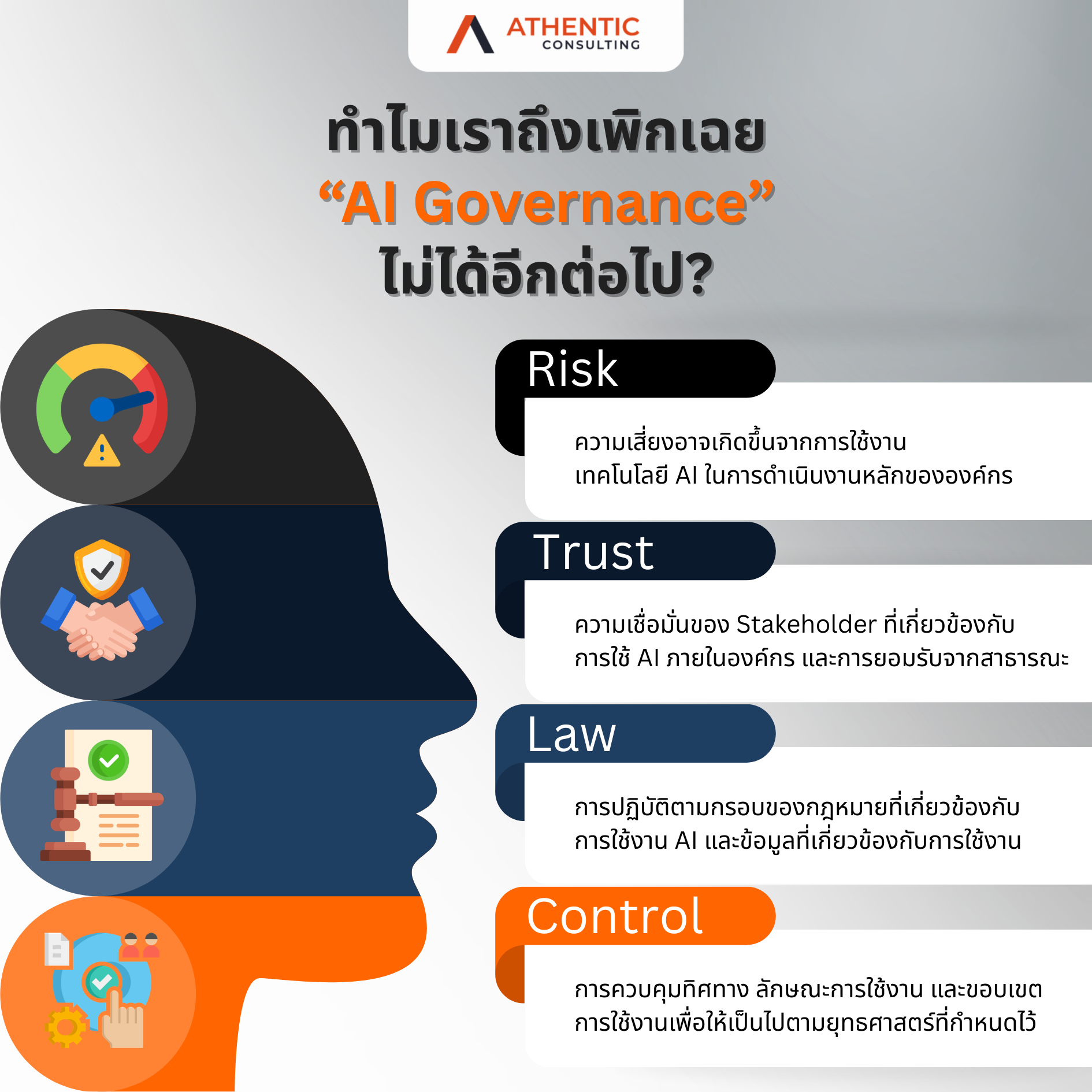
Ensuring that organizations implement AI in alignment with established standards, legal requirements, and ethical principles has therefore become unavoidable. For this reason, both public and private organizations can no longer afford to ignore “AI Governance.” Today, Athentic Consulting invites you to explore four key AI governance considerations that organizations should prioritize.
The growing adoption of AI brings increasingly complex and diverse risks. Many organizations have begun recognizing these risks and are implementing structured management approaches. Common risks include cybersecurity threats, intellectual property infringement, and violations of personal data privacy. Studies indicate that approximately half of organizations using AI have experienced negative consequences related to these risks.
One example of AI’s growing complexity lies in the scale of its impact. Consider the use of AI in loan approval processes within the financial sector. Previously reliant on human evaluation, financial institutions now leverage AI to analyze data and support decision-making, enabling faster loan approvals and broader access to credit. However, this increased speed and scale also amplify potential risks. If AI models or underlying data contain flaws—such as embedded bias—errors may rapidly affect a large number of borrowers, potentially impacting financial system stability and organizational credibility. Therefore, organizations should establish appropriate risk management frameworks and methodologies.
The success of AI implementation depends not only on technological capability but also on the level of trust an organization builds with employees, customers, and stakeholders. Organizations that succeed in AI adoption implement clear and comprehensive approaches to foster trust alongside technological deployment. For example, in the retail sector, Amazon utilizes AI for inventory management, demand forecasting, personalized product recommendations, and warehouse optimization. Importantly, these applications operate alongside transparency measures and strong data quality controls to ensure accurate results that meet customer expectations. When users trust AI systems, that trust becomes a sustainable driver of long-term business value.
Furthermore, organizations must consider the accuracy and explainability of AI outputs. AI systems may generate content that appears credible and coherent but is not factually correct—commonly referred to as AI hallucination. If employees rely on AI-generated content without proper verification, it may lead to negative consequences for the organization. Therefore, organizations should establish mechanisms to review and monitor AI usage in order to reinforce trust and reliability.
Compliance with legal and regulatory frameworks governing AI and data usage is a core pillar of AI governance.
In the European Union, the EU Artificial Intelligence Act (EU AI Act) has been enacted as the world’s first comprehensive AI-specific legislation. It adopts a risk-based approach, categorizing AI systems into four levels ranging from minimal to high risk. High-risk AI systems are subject to stricter requirements, including data governance, risk assessment, transparency obligations, and lifecycle oversight. In addition, AI systems involving personal data processing must comply with the General Data Protection Regulation (GDPR), which governs data processing activities carried out by AI systems.
Meanwhile, Thailand has begun drafting AI-related legal principles to establish a governance framework aligned with national context and international standards. Organizations in Thailand should proactively prepare for AI governance to adapt to regulatory changes and ensure compliance with emerging legal standards.
Implementing Artificial Intelligence (AI) within organizations requires clear direction, defined usage boundaries, and alignment with corporate strategy and objectives. Without appropriate control mechanisms, AI deployment may become fragmented, misaligned with organizational policies, or expose the organization to legal and operational risks.
AI Governance plays a vital role in establishing a structured management framework, encompassing governance structures that define roles, responsibilities, and decision-making authority; AI strategies aligned with organizational objectives, including appropriate use-case selection and human-in-the-loop considerations; and AI operations management throughout the entire lifecycle—from design and development to testing, deployment, and post-implementation monitoring.
As we transition into a new era of work and technology, AI has become an essential tool. More importantly, AI Governance serves as a foundational framework that enables organizations to manage risks, build trust, ensure legal compliance, and control AI deployment effectively. Organizations that establish a strong AI governance foundation today will gain a competitive advantage in leveraging AI to create both business and societal value in the long term. This ultimately answers the critical question: “Why can we no longer afford to ignore AI Governance?”