
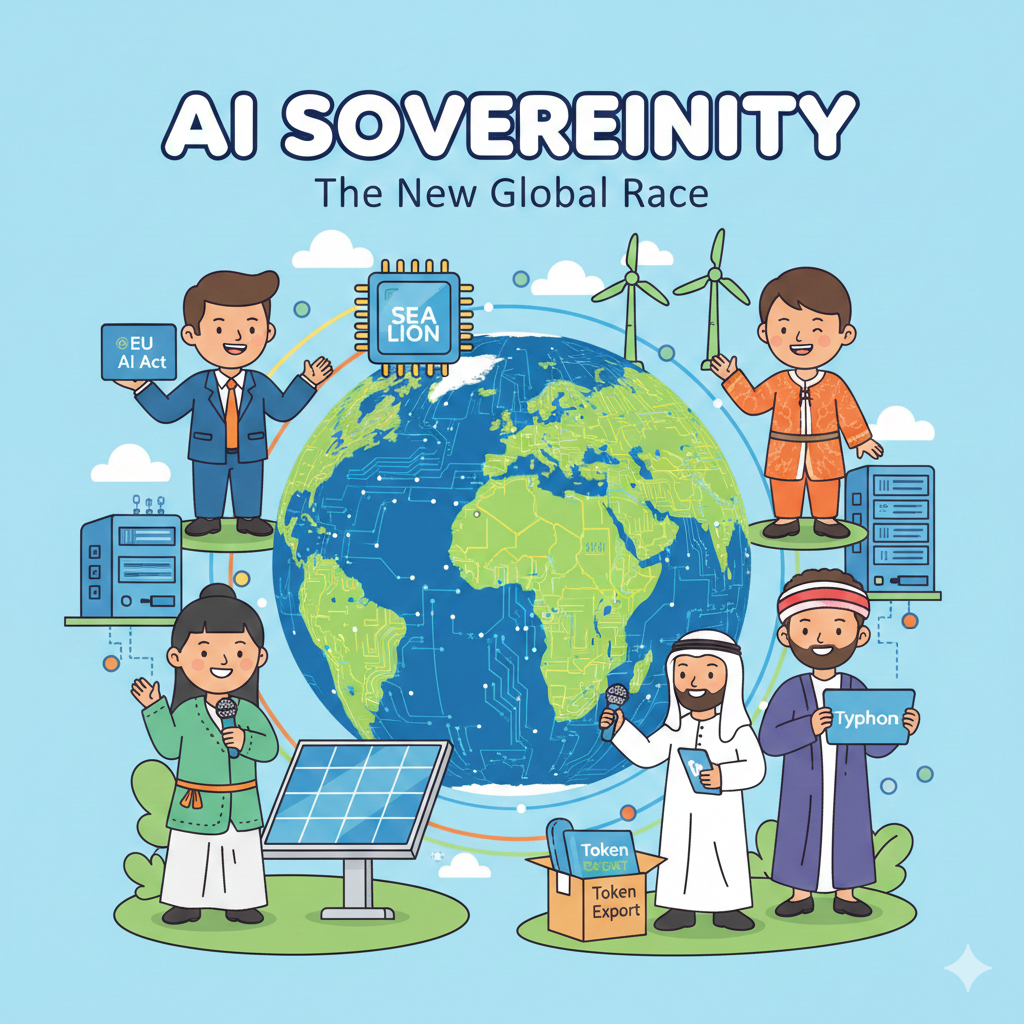
In an era where Artificial Intelligence (AI) is transforming the world rapidly and profoundly, geopolitical risks remain high. This has led nations worldwide to recognize the importance of "AI Sovereignty." This concept is not just about owning AI technology; it refers to a nation's ability to develop, control, and utilize AI independently, aligned with its own values, culture, and national security.
A report from Stanford University’s Human-Centered Artificial Intelligence (HAI) in December 2025, analyzing key AI trends for 2026, states that many countries will place a high priority on "AI Sovereignty." This is to demonstrate independence from major AI providers and a lack of reliance on the U.S. political system. AI Sovereignty means each country controls and governs AI technology itself. For example, some nations may develop their own Large Language Models (LLMs), while others may choose to use external models but process them on their own infrastructure to prevent data from leaving the country. However, the definition of "sovereignty" is not yet clearly defined and is currently under analysis to understand its various forms and approaches (James Landay, HAI Co-Director).
Current AI competition is not limited to the two superpowers, the United States and China. Countries from Europe, the Middle East, to Asia—including Thailand—are striving to build their own AI capabilities. Every region has different reasons and strategies for developing AI Sovereignty. I would like to invite you to consider these points.
According to the United Nations Internet Governance Forum (IGF), AI Sovereignty is defined as "the ability of a country to understand, gather, and develop AI systems while maintaining control, decision-making power, and ultimately, self-determination over those systems." From this definition, it is clear that this is not just about technology, but about having the full authority to determine how this technology is developed and used within each country's context.
There are several key reasons why countries seek AI Sovereignty:
1. Economic security and self-reliance: Relying on successful AI from abroad with a large user base confirms readiness and saves massive investment costs. However, it carries hidden economic and security risks. In a worst-case scenario involving trade disputes or geopolitical tensions, critical AI models could be cut off immediately—as seen with the United States limiting the export of advanced GPU chips to certain countries.
2. Preservation of cultural and linguistic identity: Most AI models developed by big tech companies are trained primarily on English-language data. While many businesses globally believe translating English outputs is sufficient, many governments now see the limitations. Such models often lack a deep understanding of the cultural context, language nuances, and values of other nations. As the developers of Singapore's SEA-LION have noted, there is a concern regarding "West Coast American bias" in global LLMs.
3. Data security and privacy: Using foreign AI models may mean sensitive data from a country's citizens and organizations is sent to and stored on foreign servers. This data may be subject to the laws and access of foreign governments, such as concerns over the US CLOUD Act (2018), which may grant the U.S. government the right to access data stored on American company servers, even if located abroad.
4. Future economic competitiveness: Countries with strong AI capabilities will be able to develop new industries, increase productivity, and create high-quality jobs. Meanwhile, countries without these capabilities may become mere "consumer markets" for foreign AI technology.
According to a study by the World Economic Forum, developing AI Sovereignty requires diverse and sustainable cooperation across several key dimensions. Generally, there are six strategic pillars used as guidelines for countries to strengthen their AI capabilities:
1. Digital Infrastructure: The backbone of AI Sovereignty is robust digital infrastructure. This includes modern Data Centers with high-performance computing power capable of efficiently handling massive amounts of data. Although Data Centers do not directly employ a large number of people, they are a vital upstream industry for a country's technological and digital economic development. Having modern and capable Data Centers promotes various other industries, from software development and cloud services to AI research. It also helps in complying with data protection and privacy laws, as data can be stored and processed within the country's jurisdiction. Furthermore, it reduces latency in accessing data and services, which is crucial for AI applications requiring real-time responses, such as autonomous vehicles, telemedicine, and manufacturing.
Data localization policies also ensure that data generated within the country is stored and processed locally, enhancing data security and sovereignty. These infrastructures are essential foundations for the effective development and application of AI technology. For example, Saudi Arabia is building massive data centers with over 6.6 gigawatts of capacity to support national AI development.
2. Workforce Development: A recent report from the McKinsey Global Institute (November 2025) found that future work will involve collaboration between humans and AI. Traditional human skills remain important but must adapt to new contexts. Demand for digital and AI skills will rise rapidly, and with proper preparation, this transition will create immense economic value.
Having a skilled workforce is a critical factor for AI technology development. Education in Science, Technology, Engineering, and Mathematics (STEM) encourages students and workers to use AI creatively and productively. This foundation starts with updating curricula at all levels to include AI and Machine Learning, as well as vocational training and lifelong learning opportunities. Investing in human capital ensures a country has the experts ready to continuously drive the AI industry and innovation.
3. Research, Development, and Innovation (RDI): Investing in RDI is the heart of expanding AI capabilities. Governments should focus on both budget allocation and support measures for basic and applied AI research. This includes creating tangible metrics for evaluation to ensure budgets are used correctly and efficiently, as well as pushing for commercialization. Ultimately, an innovation ecosystem must be built that fosters collaboration between the business sector (both startups and large corporations) and academic/research institutions, driven by government agencies, private sectors, and investors. This open innovation network will facilitate collaboration, partnership matching, and investment, leading to progress that pushes the country onto the global AI stage.
4. AI Governance: Regulatory and Ethical Framework: Balancing innovation with ethical and legal considerations is paramount, especially in the context of AI. Establishing a comprehensive governance and ethical framework should include clear guidelines and practices for AI development and application, such as privacy, transparency, data protection, cybersecurity, and ethical AI usage. This framework should also have systems for oversight, auditing, and accountability to ensure AI is used appropriately and for the benefit of society (Responsible AI).
5. Stimulating the AI Industry: This involves creating an environment conducive to business growth and AI application, particularly in key sectors like energy, healthcare, finance, transport, and manufacturing. Government measures such as tax incentives, grants, and streamlined patent processes will support AI innovation and entrepreneurship. Additionally, the government's own adoption of AI serves as a leading example and stimulates growth, including building public-private partnership models to accelerate AI development for solving social issues and driving the economy.
6. International Cooperation: While building AI Sovereignty emphasizes internal capacity, international cooperation remains vital. Negotiating and building alliances with other countries will help define global AI standards, facilitate cross-border data exchange under agreed rules, and help tackle shared challenges like privacy issues and cyber threats. Furthermore, collaborating on international projects helps pool resources and knowledge to accelerate AI progress for mutual benefit.
The path to achieving AI Sovereignty is complex, requiring careful and continuous strategic planning at the national level. When a country embarks on this path, the goal is not isolation from the world, but to avoid being left behind in a rapidly changing digital era, while protecting its interests and gaining a competitive advantage on the international stage.
- Why the United States and China lead
The United States and China are undoubtedly leaders in AI for several reasons. First, both countries have big tech companies with immense resources, such as Google, Microsoft, Meta, and Amazon in the U.S., and Alibaba, Baidu, and Tencent in China. These companies spent tens of billions of dollars on AI research and development. In the first half of 2024 alone, Microsoft, Amazon, Google, and Meta combined spent over $100 billion on AI infrastructure and cloud systems.
Second, both countries have robust research ecosystems. The U.S. has world-class universities and research investment from both the public and private sectors. China has massive government investment and produces a large number of AI researchers from top universities. For instance, DeepSeek, a leading Chinese AI lab, has more than half of its researchers graduated solely from Chinese universities.
Third, access to Big Data. U.S. tech companies have data from billions of users worldwide, while China has a population of over 1.4 billion and high digital usage. This data is the essential fuel for training AI models. Finally, both countries produce and have access to advanced GPU processing chips. The U.S. has Nvidia, which dominates 90% of the AI chip market, while China is investing heavily in developing its own semiconductor technology.
- Countries Competing for the Third Spot
The race to be the third-place global AI player is just as intense, with several countries and regions investing heavily to build strong AI capabilities.
The European Union is a key player with the EuroHPC project, which has a budget of approximately $2 billion. Although much less than big tech companies, the EU has strengths in governance, leading the development of AI regulations like the EU AI Act—the world's most comprehensive law. France has invested in "cloud de confiance" (trusted cloud) infrastructure and the Jean Zay supercomputer, which features 1,456 Nvidia H100 GPUs.
The United Kingdom has strengths in basic research and top universities, establishing the Alan Turing Institute and investing in AI research through UK Research and Innovation (UKRI). The UK's approach emphasizes balancing the promotion of innovation with appropriate oversight.
Canada has announced a Sovereign AI Compute Strategy worth 2 billion Canadian dollars, focusing on reducing barriers to computing resources for researchers, startups, and organizations with limited resources. Canada has a human capital advantage, being the birthplace of many renowned AI researchers like Geoffrey Hinton, Yoshua Bengio, and Yann LeCun.
Japan has developed ABCI 3.0 in collaboration with Hewlett-Packard Enterprise and Nvidia, designed to deliver 6 AI exaflops of performance with thousands of Nvidia H200 GPUs, making it one of the most powerful accessible AI supercomputers in the world.
- Switzerland: Investing with Quality and Academic Excellence
Switzerland demonstrates an approach focused on quality and academic excellence in developing AI Sovereignty. The country invested in building the Alps supercomputer, ranked 8th most powerful in the world, and developed the Apertus model—an open-source large language model trained on over 15 trillion tokens in over 1,000 languages, with more than 40% being non-English.
The highlight of the Swiss approach is transparency and accountability. Apertus is completely transparent, disclosing all training data and checkpoints during development, unlike big tech models which are often kept secret. Furthermore, the model prioritizes compliance with copyright laws and data protection, with mechanisms for content owners to request their data be removed from the training set.
Switzerland's success stems from combining the academic expertise of leading institutions like ETH Zurich and EPFL with government support and a long-term vision for building digital infrastructure. However, Switzerland faces the challenge of lacking resources on the same scale as AI superpowers like the U.S. and China, and reliance on importing GPU chips from abroad.
- Latin America: The Challenge of Creating Unity in Diversity
Latin America is working on Latam-GPT, a regional effort to create a language model that understands the region's context. The model has about 50 billion parameters, similar to GPT-3.5, and uses over 8 terabytes of data from over 30 institutions across Latin America, led by Chile through the Chilean National Center for Artificial Intelligence Research (CENIA).
The main challenge for Latin America is creating unity across linguistic and cultural diversity. The model must support both Spanish and Portuguese, including various indigenous languages, and understand "code-switching" common in the region. Additionally, the region faces geopolitical competition between the U.S. and China, as both sides try to draw countries in the region into their respective AI ecosystems.
Brazil has announced a $4 billion AI plan over four years, focusing on building technological sovereignty through domestic models and computing power, while pushing for global rules via the G20 and the UN. Meanwhile, Chile positions itself as the region's digital hub, attempting to balance relationships with both superpowers.
- SEA-LION: Singapore's Southeast Asian Language Model
Singapore has shown leadership in Southeast Asia by developing SEA-LION (Southeast Asian Languages In One Network), an open-source large language model designed to support 11 major regional languages, including Thai, Vietnamese, Indonesian, Filipino, Burmese, Malay, and Lao.
This project is supported by the Singapore government with a budget of approximately 70 million Singapore dollars (around 1.8 billion baht).
SEA-LION was developed by AI Singapore, a national network of AI research institutes and organizations. The model has two versions: 3 billion and 7 billion parameters, and was trained on 1 trillion tokens (5 terabytes), with 13% being ASEAN content (compared to global models like Llama 2, which used only 0.5% ASEAN content in training).
The hallmark of SEA-LION is its ability to understand cultural context and the code-switching found in the region. The model is already being used by organizations such as GoTo in Indonesia to develop Sahabat-AI, allowing users to use voice commands for Gojek and GoPay services in local languages and accents. Singapore has also made the model available for download via Amazon SageMaker JumpStart, making it easy for businesses to customize and use.
- Thailand's Progress in AI LLM Model Development
Thailand has begun developing its own AI models, most notably Typhoon, developed by SCB 10X in collaboration with the Vidyasirimedhi Institute of Science and Technology (VISTEC) and other partners like AI Singapore, Stanford HAI, and Mahidol University. This model has been continuously developed from Mistral-7B for Typhoon 1.0, and Llama 3 and Qwen2.5 for Typhoon 2, ensuring it is suitable for the Thai language and cultural context. Currently, Typhoon 2 comes in 5 sizes ranging from 1B to 70B parameters, with multimodal capabilities including Typhoon OCR 1.5, built on Qwen3-VL 2B to support Thai handwriting and complex documents. It also includes a speech-to-text system supporting both Central Thai and Isan dialects.
However, Thailand's AI development faces several challenges, including a lack of budget compared to Singapore (Thailand allocated 25 billion baht or $700 million, while Singapore invested over $26 billion). There is also a lack of computing infrastructure (only 33% of organizations have enough GPUs and there are only 0.59 data centers per 1 million people, according to UNESCO's Thailand: artificial intelligence readiness assessment report). The main challenge for Thailand's AI model development is increasing systematic collaboration between the public, private, and academic sectors, and creating clear AI policies and governance frameworks to build confidence in AI adoption.
- Saudi Arabia: Leveraging Energy for AI Power
Saudi Arabia is an interesting case study in building AI Sovereignty by leveraging its abundant energy resources. Under Vision 2030, the country is shifting from an oil-dependent economy to a hub for technological innovation, particularly AI.
Vertical Integration Strategy: Saudi Arabia has created a vertical integration strategy covering the entire AI value chain, establishing two companies under the Public Investment Fund (PIF): HUMAIN, a full-service AI company responsible for developing everything from data centers to advanced AI models; and Alat, a hardware and semiconductor manufacturing company aiming for $100 billion in investment by 2030.
HUMAIN plans to build over 6.6 gigawatts of data center capacity and procure hundreds of thousands of AI accelerator chips from Nvidia. The project begins with two data centers consisting of 11 sub-data centers, each with 200 megawatts of capacity. The goal is to have 50 megawatts ready by Q4 2025, and add another 50 megawatts every quarter in 2026.
Leveraging Energy Advantage: Saudi Arabia's core strength is cheap and abundant energy, a vital factor for running massive AI data centers that require immense power. While 64% of Saudi energy still came from oil in 2023, the country is investing in renewable energy, particularly solar and wind, under the Saudi Green Initiative.
Token Export Strategy
This strategy focuses on utilizing available energy resources by converting electricity into "computing power" and exporting results as "tokens" instead of exporting electricity directly. Saudi Arabia is the clearest example, using its low-cost solar advantage to build massive Data Centers. Other countries with similar energy resources, such as Norway (hydropower) and Iceland (geothermal), are also considering similar strategies.
India: Building AI Accessible to All
India is developing AI Sovereignty through an approach emphasizing linguistic diversity and accessibility via the IndiaAI Mission, with a budget of 10,372 crore rupees (about $1.25 billion). It focuses on building a self-reliant AI ecosystem, including computing infrastructure, homegrown foundational models, public datasets, and responsible governance.
The most important project is BharatGen, the world's first government-developed multimodal LLM. The model supports 22 official Indian languages, including text, voice, and image processing. It was developed under the National Mission on Interdisciplinary Cyber-Physical Systems (NM-ICPS) and implemented by the TIH Foundation at IIT Bombay. BharatGen aims to serve healthcare, education, agriculture, and governance tailored to each region.
Beyond BharatGen, there are other projects like BharatGPT developed by CoRover.ai, which supports over 12 Indian languages for voice and 22 for text. This model has been implemented in over 100 applications with over 1.3 billion users and integrates with Google for scaling while maintaining data sovereignty. AI4Bharat, a research project at IIT Madras, has developed multilingual models like IndicBERT, IndicBART, and Airavata, trained on IndicCorpora and Sangraha datasets. Their translation model, IndicTransv2, can compete with commercial models and supports all 22 Indian languages. They also have voice models IndicWav2Vec and IndicWhisper trained on Kathbath, Shrutilipi, and IndicVoices datasets.
The critical question is whether every country should have its own AI model. A comparison with the car industry of the past might help. In the 20th century, some countries chose to develop their own car industries, like the U.S., Japan, Germany, and South Korea, which succeeded to varying degrees. Meanwhile, other countries chose to import cars because it wasn't cost-effective or they lacked manufacturing capability.
Countries successful in the car industry usually had several factors: a large enough domestic market, continuous government support, investment in R&D, and the creation of a strong supply chain. Japan and South Korea started with low-end markets and gradually developed technology until they could compete with Europe and America.
Similarly, having one's own AI model requires similar factors: a sufficient market and user base, government support, long-term investment, and a complete ecosystem. However, there are key differences. First, AI model development requires massive capital and resources at the start, which may not be cost-effective for small countries. Second, AI has a stronger network effect; models with more users get more data, making them progressively better.
However, unlike the car industry which requires large factories and complex supply chains, AI models are easier to develop using Open Source and fine-tuning existing models. Therefore, small countries might not need to build models from scratch but can customize Open Source models to their needs—much like many countries have car assembly industries without manufacturing every part themselves.
For countries with unique languages or cultures, having an AI model that understands specific contexts may be necessary, just as some countries have car industries to meet specific needs (e.g., 4WD vehicles in rugged terrain). Conversely, countries with languages close to major ones or with small markets may not find it worthwhile to invest in developing their own models.
AI Sovereignty has become a key strategic issue for countries worldwide. Having one's own AI capabilities not only reduces foreign dependence and increases economic security but also helps preserve cultural identity, language, and values.
Case studies from various countries show there is no one-size-fits-all approach. Switzerland demonstrates the power of academic excellence and transparency. Latin America reflects the challenge of creating unity in diversity. Singapore shows the success of national planning and agency collaboration, while Saudi Arabia and the UAE leverage wealth and energy to gain a competitive edge.
For Thailand, the key lesson is the need for a long-term vision and serious investment, fostering collaboration between public, private, and academic sectors, and leveraging regional cooperation in ASEAN. Thailand does not need to compete directly with AI superpowers but should focus on building capabilities suitable for its context and needs, including building strong infrastructure and developing a quality workforce.
Ultimately, AI Sovereignty is not about isolation or non-cooperation with the world, but about finding a balance between self-reliance and utilizing international cooperation. The goal is to ensure that a country is not left behind in the rapidly advancing global digital race, while protecting its own interests and values.