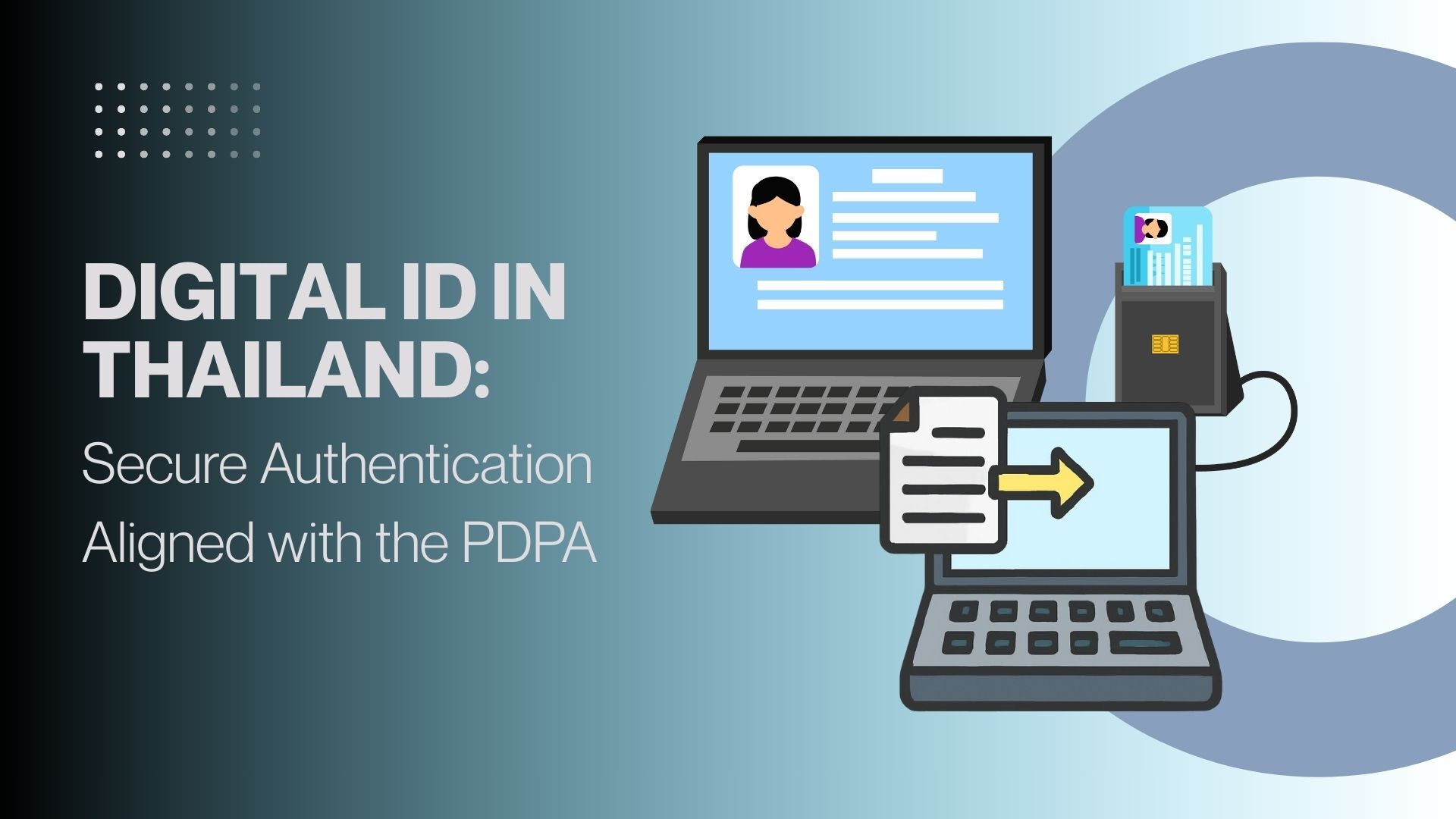
According to ETDA, “Digital ID” refers to an identity or personal information collected in a digital format, such as an identification number, name, address, or Biometric data, among others. It is used to identify and verify a person’s identity when accessing services provided by both public and private organizations. This article will discuss how Digital ID has been used in Thailand, how it benefits personal data protection, and how it abides by the Personal Data Protection Act (PDPA).
“Identity verification” is the process of collecting and verifying information about an person’s identity that the person and their identity information are real and related. Before the widespread use of computers and technology, identity verification worldwide—including in Thailand—has relied heavily on physical documents such as ID cards, passports, or driver’s licenses. People had to bring these documents to places for verification. This process was always complicated, requiring people to prepare multiple documents and travel to verification locations. It might occur the chance of personal data leakage, and personal information was disclosed more than necessary.
Nowadays, Thailand has developed Digital ID technologies to make identity verification more convenient. The most well-known example is the “ThaID” application by the Department of Provincial Administration (DOPA). Once verified through ThaID, users can access various government services—such as online tax filing, e-petitioning for legislation, digital health records, and consumer complaints systems—without re-verifying their identity each time.
To ensure standardization, government agencies must comply with Digital Government Standard DGS 1-2 (2564): DIGITALIZATION: DIGITAL ID - IDENTITY PROOFING AND AUTHENTICATION. The system must follow two key assurance standards:
The chances of personal data leakage form using digital ID is upon different levels of Data Protection.
In conclusion, Existence of Digital ID is beneficial to Personal Data in the process of identity verification as in the table below:
| Benefit Digital ID | Details |
| Reduces personal data leakage | Digital ID was introduced to help reduce the risk of data leakage from using physical documents. Users can authenticate digitally without repeatedly presenting real documents, which reduces unnecessary exposure of personal data and lowers the risk of personal data leakage. |
| Data minimization | Digital ID was designed to collect only necessary data, unlike document-based verification where full personal details may be unintentionally disclosed. |
| Reducing data redundancy | Digital ID helps reduce redundant steps and process for identity verification, also enhance convenience and agility in data governance by enabling the reuse of existing verified data across services (e.g., using ThaID data for tax filing or accessing Health Link). |
| Security measures | Digital ID systems are required to follow digital government security standards set by the Digital Government Development Agency (DGA). |
Digital ID authentication uses personal data (e.g., name, gender, national ID number, religion, facial images, or fingerprints) for identity verification and must comply with the security standards set by the Digital Government Development Agency (DGA). Under the PDPA, Digital ID is relevant and aligned to the PDPA as follows:
For Digital ID authentication, the related role in PDPA involves:
Because Digital ID authentication involves processing personal data, processing must rely on one or more lawful bases under Section 24 and Section 26 of the PDPA. To specify the legal basis, it is depending on context—such as the controller’s role, type of data and purpose of collecting it.
For example, The activities of registeration and accessing the Digital ID system, which involve collecting identity data of service users (e.g., first name, last name, photograph, and signature), may rely on the contractual necessity basis under Section 24(3) for the purpose of registration and access to the system.
To ensure that identity verification via Digital ID complies with the Personal Data Protection Act (PDPA), the Digital ID service provider, as a Data Controller, must consider and implement the required legal documentation under the PDPA as follows:
Moreover, the Digital ID service provider, as the Personal Data Controller, must review processing activities related to the provision of Digital ID services. For example, if personal data is disclosed or transferred to external organizations, it may be necessary to prepare additional legal documentation, such as a data processing agreement (DPA) or to have appropriate security measures to ensure compliance with the Personal Data Protection Act (PDPA).
The development of Thailand’s identity verification via Digital ID system not only enhances the efficiency of public and private services but also strengthens personal data protection for both service provider who have to comply with PDPA and for the users who should be aware of their rights on personal data protection so they can use Digital ID safely with confidence. It reduces the risk of data breaches, establishes secure and transparent authentication standards, and complied with the Personal Data Protection Act. Ultimately, Digital ID helps create public trust in digital identity systems, promotes paperless activity, and contributes to improving data subjects’ quality of life in this technology era.
References
• ETDA Digital ID Standard (DGS 1-2, 2021): https://standard.dga.or.th/wp-content/uploads/2021/09/3.Digital-ID-DGS-1-2_2564.pdf
• DOPA Digital ID Overview: https://multi.dopa.go.th/icad/assets/modules/news/uploads/...
• ThaID Application Information: https://www.bora.dopa.go.th/app-thaid/