
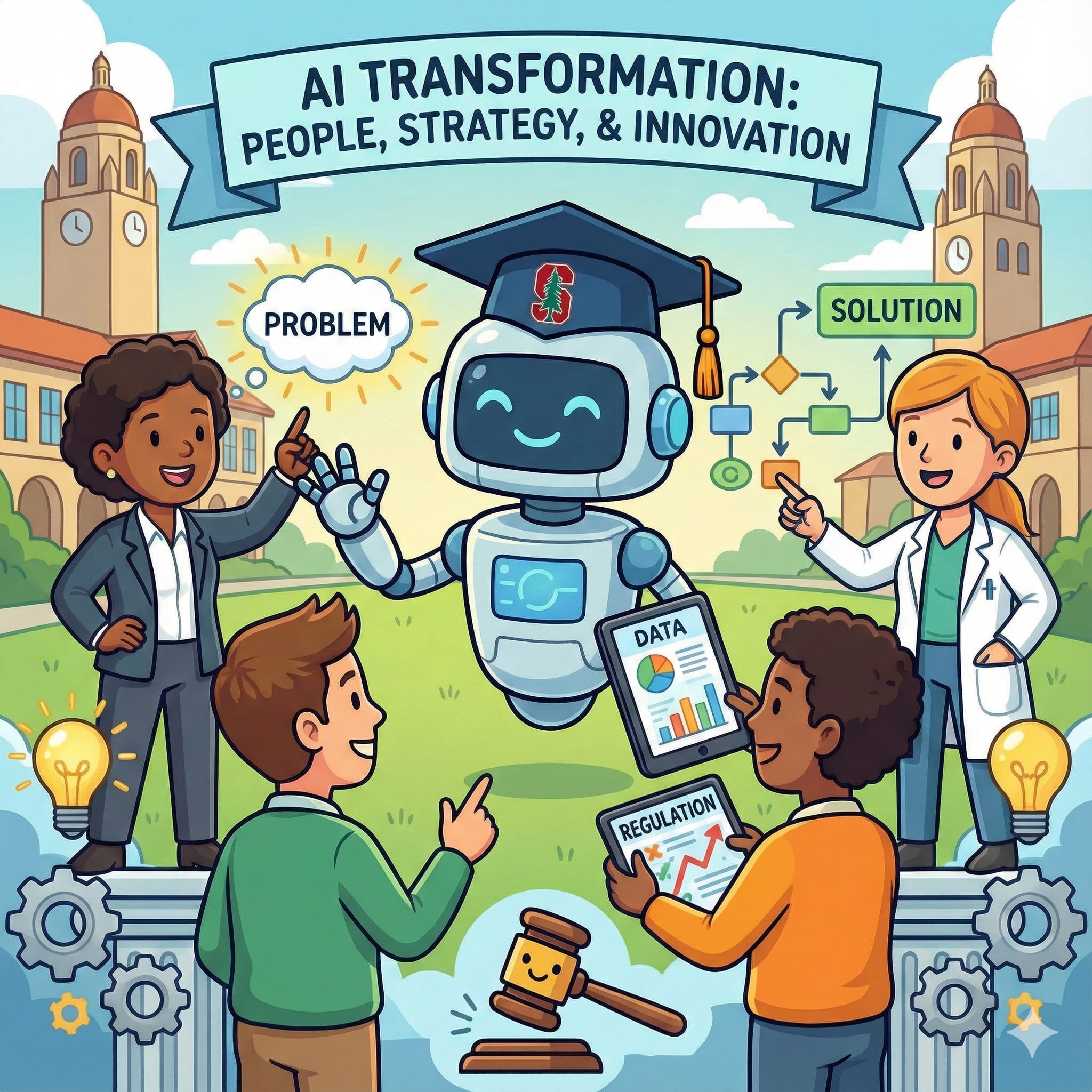
In late October, I had the opportunity to attend the "Harnessing AI for Breakthrough Innovation and Strategic Impact" course at Stanford University. This course was developed through the collaboration of several faculties within the university, including the Stanford Institute for Human-Centered Artificial Intelligence (HAI). In this article, I would like to summarize the key points from the training to share with you as follows:
Although Stanford is a university focused on Innovation and Engineering, this course brought together faculty and experts from various fields to design an AI drive that benefits both the business sector and society. Almost every professor and expert emphasized that driving AI cannot rely solely on technological advancements. It requires cooperation from all parties, whether they are technology experts, data experts, legal experts, process experts, or every employee in the organization. This means that driving AI necessarily involves driving organizational culture as well, making Change Management—in terms of both work processes and people—something that must be done in parallel.
Step 1: Know what you want AI to do (Objective)
Focus on the problem. We must start by looking at our problem first, not immediately thinking about technology or solutions. The goal must be clear. For example, if we use AI in the Machine Learning aspect to help make predictions, we must determine what important things AI should predict for our business. Then, we move to Prioritization to rank what AI should predict first and what comes later.
Step 2: Know what Data to use to teach AI
Our own data is the most valuable data. We must be able to convert that data into Machine learnable data. The next question is: what kind of data should we rush to collect?
Data in your organization is your most valuable asset. Start maintaining and managing it today, even if you are not sure what kind of AI use case you will do, how you will do it, or how much data you will use. Having a large amount of quality data will create an advantage in AI transformation. And if we understand our organization's data well, the various AI agents created will generate value for us.
Step 3: Interpret the results correctly (Judge)
In the AI process, another important task is analyzing and interpreting what AI predicts. For most people in the organization who are not "AI humans," this point is your strength in the AI transformation process because analyzing or interpreting forecast results requires business understanding to lead to our further business decisions.
In this training, the course invited several professors from the Business School to provide perspectives on driving AI. This reflects that driving AI successfully involves more than just Technology. Prof. Burgelman stated that strategy is a state of mind or concept that we want to have in order to control or determine our own goals. For an organization to be stable and sustainable, it must have Strategic Leadership, which consists of two main parts: the first is the thought that drives action to succeed in cooperation and competition; the second is the organization's ability to control the organization's purpose.
Having a leadership strategy that focuses only on success is not enough to make a company or society as a whole sustainable, because success is not always happiness. Fundamentally, humans desire happiness on an individual, organizational, or societal level. From this point, organizational leaders or national leaders need to give importance to governance in driving rapidly changing technologies like AI.
regarding driving an organization, no matter how good the strategy is, if the practical guidelines or organizational culture do not facilitate or support it, it is difficult to see that strategy succeed. As the saying goes, "culture can eat strategy for breakfast and can eat technology for lunch and dinner." Ultimately, organizational culture is the organization's way of practice—how it treats people in the organization and how people in the organization treat each other. It also includes work processes and how people in the organization operate. When new technology comes in, how will that process be adjusted? How to make it less siloed? Because there is probably no organization that can introduce new technology and have everyone accept it immediately. But having a strategy will help people in the organization do things they don't want to do with alertness and excitement. This doesn't just mean excitement about new working methods, but also excitement about the benefits that will occur to the organization and its people when following the laid-out strategy. For this reason, we must create indicators and fair evaluations that ensure people in the organization who are willing to tire themselves to adjust work processes truly benefit from it, whether in the form of better compensation or more efficient work with less fatigue. The 3 main points of organizational strategy to think about when doing AI Transformation are:
In the past, the mindset framework related to organizational strategy was Wisdom > Knowledge > Information > Data. But the arrival of AI has changed this perspective to Big data/information x Computation = Power. What we need to realize is that we still need Wisdom to use that Power.
Measuring the return on AI (AI ROI) can be divided into steps as follows:
Step 1: Define goals clearly
How important is this to your business? Is it a "Must-have" (keeping the business competitive) or does it create an advantage (using data or company strengths to outperform competitors)? Is it a new business model? Specify the goal clearly and how to measure it.
Step 2: Calculate all costs
Cost of the AI model, labor costs, and labor savings, IT costs. Look for opportunities to share costs. Don't waste money on small, one-off cases. Identify the benefits, such as increased revenue or improved productivity. Clearly specify which tasks change from human to computer and how it affects expenses.
Step 3: Hidden costs
Because there are no clear examples yet, cost estimates for data, system integration, and security are often underestimated. Resistance from organizational culture or fear of losing jobs. Retraining costs. Reduce risk by planning to stop or change projects quickly.
Step 4: Overlooked benefits
Learning! This project might make other future projects easier or cheaper.
You can build upon existing foundation models significantly because building one requires massive amounts of money and resources. For example, GPT-3 has 96 layers, 175 billion parameters, and 570 GB of data for model training. GPT-4 was developed using multimodal language techniques, but data details were not disclosed (OpenAI claims this is for AI safety and competitive advantage). Even among tech giants, there is fierce competition in developing Large Language Models. Currently, there are many LLMs, and they will continue to increase. The issue is that these companies are racing using similar data to train models, resulting in similar answers from models and facing the same types of problems. This trend may continue until we have a major shift from a new type of model that solves problems in a different way.
The highlight of machine learning is prediction by taking existing data and converting it into things we didn't know before. In this process, humans must make decisions based on the forecast. The AI-driven approach needs to view management challenges as prediction problems.
AI models are not always perfect; there is always room for development. Models may hallucinate or show symptoms of sycophancy (pleasing the user). But in the future, models will be improved to better meet objectives. However, the larger the model size, the more data and energy it requires.
AI is like other technologies that have both pros and cons, depending on how we choose to use it. But for technology use to truly benefit the majority, we need to establish rules, regulations, and etiquette for developing and using AI to ensure it is Robust, Fair, Simple, Transparent, and Responsible.
Regulating AI technology has key considerations: How to regulate, What should be regulated, When to start regulating, and Who is responsible for regulation.
Future Challenges: In the future, each industry may need to issue its own specific AI care standards because AI will be used more specifically (from previously general use). Specific regulation for each field will become more important.
Actually, there are still many good concepts and insights from having the opportunity to attend this course. I will gradually write more for you to read. In this article, I would like to conclude by summarizing: if we want to bring AI into our organization, what steps should we take?